Sacred and Unfinished: How Indian Aesthetics Can Free Americans from the Tyranny of Perfect
There is a particular kind of exhaustion that visits the American achiever in the quiet hours — the hollow feeling that follows the completion of something that was supposed to feel triumphant. The project is done. The product is launched. The body has been sculpted to specification. And yet, the relief is fleeting, replaced almost immediately by the question: What still needs to be fixed?
This is not a personal failing. It is the logical consequence of living inside a culture that treats incompleteness as a problem to be solved, a gap to be closed, an inadequacy to be overcome. American perfectionism is not merely a personality trait; it is a civic religion. And like all religions, it shapes what we consider beautiful, what we consider worthy, and what we allow ourselves to rest inside.
India's oldest artistic and spiritual traditions offer a strikingly different theology — one in which the unfinished is not a wound but a window.
The Raga That Does Not Resolve
Consider the structure of a classical Indian raga. To a Western ear trained on the satisfying cadences of European composition — the dominant chord resolving neatly to the tonic — certain ragas can feel disorienting. They rise, they explore, they create tension of extraordinary beauty, and then they... breathe. They do not always land where expectation demands. Some ragas, particularly those associated with twilight or the liminal hours before dawn, are designed to hold the listener in a state of suspension, in what Sanskrit aesthetics calls viyoga — a kind of longing that is itself the experience, not merely the prelude to one.
The great musicians of the Hindustani and Carnatic traditions understood that a raga which resolves too cleanly teaches the listener nothing about dwelling inside uncertainty. The incompleteness is pedagogical. It is the master saying, without words: learn to be comfortable here, in the space between the note and its answer.
For Americans conditioned by the three-minute pop song — verse, chorus, bridge, resolution — this is genuinely radical. The raga does not owe you closure. And in withholding it, it offers something more valuable: the capacity to find peace without it.
Stone Left Uncarved: The Temple's Deliberate Asymmetry
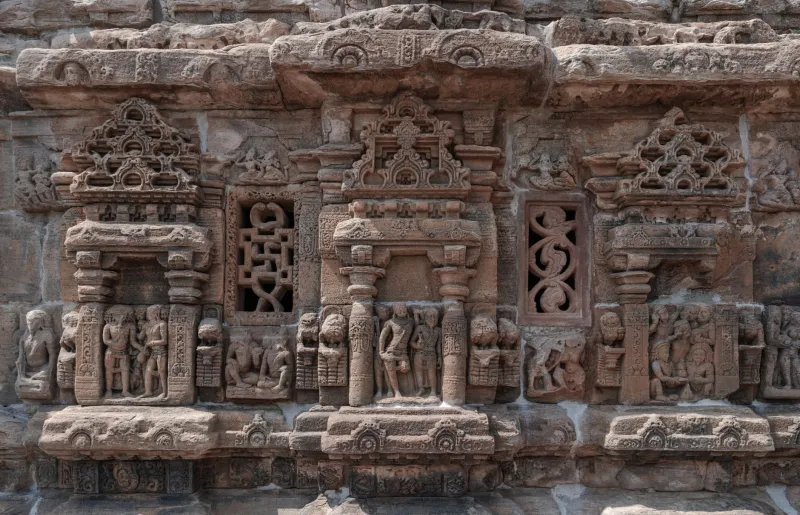
Travel through the temple corridors of Khajuraho, Hampi, or the great Dravidian complexes of Tamil Nadu, and a trained eye will notice something that initially reads as imperfection. Carvings left partially unfinished. Pillars whose ornamentation fades before completion. Figures that dissolve back into raw stone as though the sculptor simply stopped mid-gesture.
This was rarely an accident of resources or time. Many of these absences were intentional, rooted in the belief that only the divine could truly complete a work of sacred art. The human artist's role was to begin, to offer the work upward, and then to release it. To finish everything would be to claim a completeness that belongs only to the infinite. The uncarved stone was not a failure of craft; it was an act of humility encoded in architecture.
Compare this to the American renovation culture, in which a house is never quite finished, a body never quite optimized, a career never quite arrived. The difference is not in the presence of incompleteness — both cultures live with it — but in what that incompleteness means. In the temple tradition, the unfinished is a threshold. In the wellness-industrial complex, it is a deficiency.
Open Endings as Spiritual Practice
Indian storytelling, too, has long resisted the Western hunger for the sealed conclusion. The Mahabharata, at its vast and unwieldy heart, refuses to deliver the kind of moral tidiness that American narrative culture demands. Characters are neither purely heroic nor purely villainous. Dharma, the sacred principle of righteous action, is shown to be contextual, contested, and sometimes paradoxical. The epic ends, but it does not conclude in the way a Hollywood screenplay concludes. It leaves the reader holding questions that were never meant to be answered, only carried.
This is not a failure of craft. The ancient storytellers were sophisticated beyond measure. The open ending was a deliberate invitation into vicara — sustained contemplation — rather than the comfortable closure of a lesson delivered and absorbed.
For a culture that reflexively reaches for the TED Talk summary, the five-step framework, the actionable takeaway, this is a genuinely challenging proposition. What if the story's value lies precisely in what it refuses to explain?
What Perfectionism Actually Costs
The research on perfectionism in the United States is not encouraging. Studies consistently link perfectionist thinking not to higher achievement but to chronic procrastination, creative paralysis, anxiety disorders, and burnout. The perfectionist does not produce more; she produces less, and suffers more in the producing. The optimization culture, despite its promises, often delivers a kind of creative rigor mortis — the inability to begin because beginning means living with imperfection, and imperfection has been coded as intolerable.
The Indian aesthetic principle that incompleteness can be sacred does not counsel laziness or indifference to quality. The musicians who let a raga breathe without resolution have spent decades mastering their instruments. The temple sculptors who left stone uncarved were among the most technically accomplished artists of their era. The invitation is not to stop caring about craft. It is to stop confusing craft with control.
There is a distinction, subtle but vital, between doing one's finest work and demanding that the work be finished in a way that satisfies the ego's hunger for completion. The first is devotion. The second is a kind of spiritual greed.
Learning to Leave the Door Open
What might it look like, practically, to absorb this principle into American creative and spiritual life? It might mean releasing a piece of writing that is good rather than waiting for it to be perfect. It might mean allowing a conversation to end without resolution, trusting that the unresolved feeling is doing its own work in the silence afterward. It might mean decorating a room with deliberate asymmetry, or learning to sit with a piece of music that does not deliver the emotional payoff it seemed to promise.
More profoundly, it might mean reexamining the relationship to the self as a project. The American wellness industry has, in many ways, repackaged the perfectionist impulse in spiritual clothing — the optimized morning routine, the quantified meditation practice, the relentless self-improvement arc. Indian wisdom does not deny the value of discipline. But it asks a harder question: Who is the one demanding to be finished?
The self, in Vedantic understanding, is not a project awaiting completion. It is already whole. The work of spiritual life is not to perfect the self but to see through the illusion that it was ever incomplete.
The Courage of the Unresolved
To embrace incompleteness is, in the end, an act of courage. It requires resisting one of the most powerful cultural narratives in America — the narrative that says your worth is measured by what you have finished, optimized, and delivered. It requires sitting inside the raga's suspension without reaching for the resolution. It requires looking at the uncarved stone and seeing not failure but invitation.
India's artistic traditions have been practicing this courage for millennia. They have encoded it in music, in stone, in story — not because they lacked the skill to complete, but because they understood that some of the most sacred things in life are the ones we are still inside of.
The gift of the incomplete is not resignation. It is liberation — the freedom to create, to live, and to be, without waiting for the moment everything is finally, perfectly done.