Stepping Back to See Clearly: The Vedantic Practice of the Inner Witness and Its Gift to the Anxious American Mind

Photo: Indian meditation serene consciousness lotus reflection calm spiritual awareness, via images.stockcake.com
Anxiety, in the American context, has become something of a cultural condition. The statistics are familiar enough to feel numbing: tens of millions of adults in the United States report clinically significant anxiety symptoms, and the numbers have trended upward with remarkable consistency across the past two decades. Pharmaceutical intervention remains the most common institutional response. Cognitive behavioral therapy offers structured relief for many. Mindfulness-based stress reduction programs have entered corporate wellness initiatives and hospital waiting rooms alike.
And yet, for a growing number of American seekers, something essential seems to be missing from these frameworks. They address the symptoms of anxiety with admirable technical precision. What they less frequently address is the fundamental question of who is experiencing the anxiety — and whether the relationship between the experiencer and the experience can itself be transformed.
It is precisely this question that Advaita Vedanta has been investigating for centuries. And its answer, crystallized in the concept of sakshi — the witness consciousness — offers not merely a technique for managing distress, but a complete reorientation of the self's relationship to its own inner life.
What the Vedantic Tradition Means by 'Witness'
Advaita Vedanta, the non-dual philosophical school associated most prominently with the eighth-century sage Adi Shankaracharya, begins with a deceptively simple observation: there is a dimension of awareness within every human being that observes thought, emotion, and sensation without itself being modified by what it observes. This dimension is the sakshi — the witness.
The witness is not a second self watching the first self from a safe distance. That framing, which is how Western popular culture often interprets the concept, misses the point entirely. The sakshi is not a separate observer stationed behind the eyes. It is, in Advaita understanding, the very ground of consciousness itself — the pure, unchanging awareness in which all mental activity arises, unfolds, and dissolves.
The practical implication is significant. If a dimension of your being is, by its very nature, untouched by anxiety — if the awareness that witnesses the racing thought is not itself racing — then the question is not how to eliminate the anxious thought, but how to shift one's identification from the thought to the awareness that contains it.
This is a fundamentally different proposition than what most Western therapeutic models offer. It does not ask the anxious person to challenge their thoughts, reframe their narratives, or regulate their nervous system through breathing techniques alone — though none of these approaches are dismissed. It asks something more foundational: Are you the thought, or are you the one who notices the thought?
The Performance of Consciousness: Sakshi as Living Theater
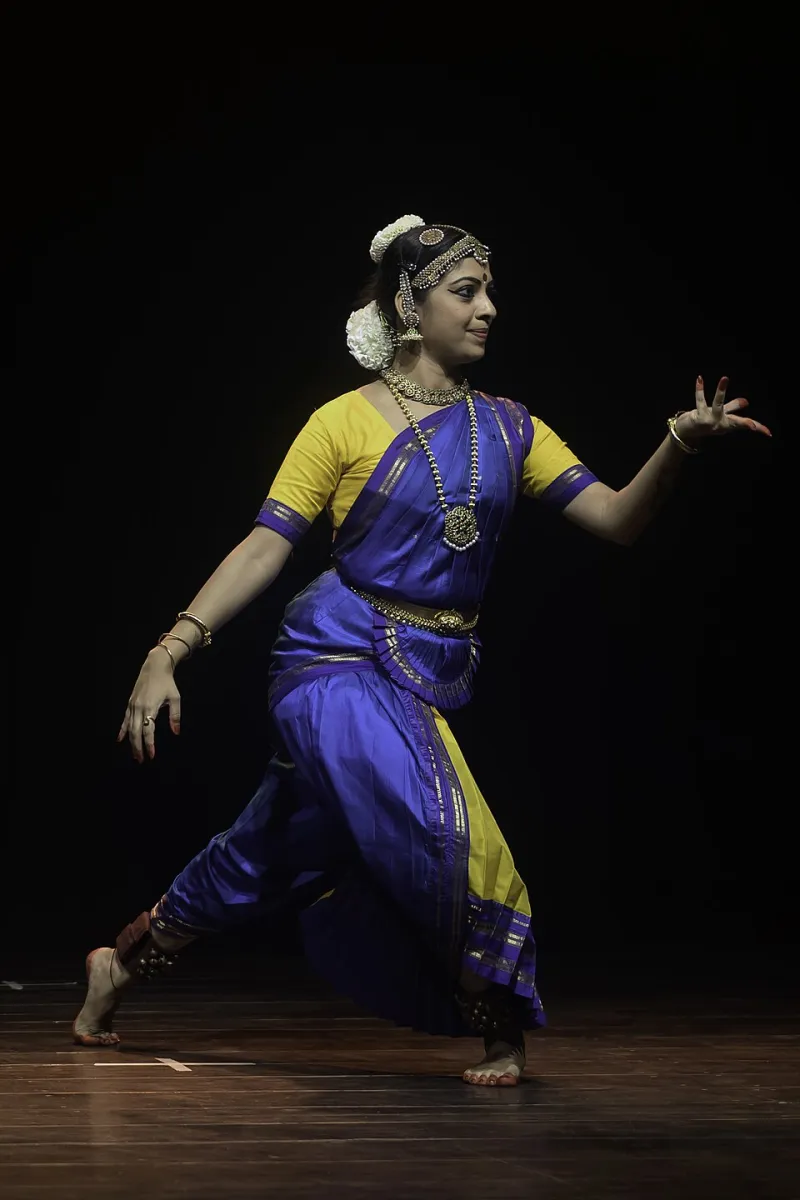
There is a dimension of this practice that resonates particularly with the language of performance and cultural expression — a language central to the Indian classical tradition. The Sanskrit theatrical treatise Natyashastra describes the ideal actor as one who embodies a character fully while simultaneously maintaining an inner awareness that is not swept away by the character's emotions. This dual consciousness — total engagement paired with unshakeable inner stability — is considered the hallmark of the accomplished performer.
In many respects, the sakshi practice asks the same of the practitioner navigating ordinary life. The anxious thought is the character. The witness is the actor who plays it without becoming it. The performance — the arising and passing of mental states — continues. But the one who witnesses it remains, in some essential sense, undisturbed.
This metaphor has proven genuinely useful for American practitioners who struggle with the abstraction of pure philosophical inquiry. When the concept is approached through the lens of performance and embodied awareness, it becomes accessible in ways that dense Sanskrit commentary alone may not achieve. Several teachers working within Indian classical traditions in the United States have noted that students who engage with the performing arts as a contemplative practice often develop a felt sense of witness consciousness more readily than those who approach it through intellectual study alone.
Where Sakshi Meets — and Surpasses — Modern Mindfulness
The contemporary mindfulness movement, largely derived from Theravada Buddhist practice and adapted for secular Western settings, has introduced millions of Americans to the practice of observing thought without immediate identification. In this respect, mindfulness and sakshi share common territory. Both cultivate the capacity to notice mental activity with some degree of spaciousness rather than being instantly absorbed into it.
The distinction lies in the philosophical architecture that surrounds the practice. Secular mindfulness, by design, brackets metaphysical questions. It offers observation as a skill — valuable, evidence-based, and genuinely helpful — without necessarily addressing the deeper question of what, or who, is doing the observing.
Advaita Vedanta is uninterested in bracketing that question. It places it at the very center. The sakshi practice is not simply a stress-management technique that happens to use the language of consciousness. It is an inquiry into the nature of the self, conducted through the laboratory of one's own moment-to-moment experience. The anxiety, in this framework, is not merely a symptom to be managed. It is an invitation — a doorway through which the practitioner may discover something about the nature of awareness that no amount of symptom-free comfort would have revealed.
Practical Entry Points for the American Seeker
For those encountering this tradition for the first time, the path into sakshi practice need not begin with advanced philosophical study. Several entry points are accessible and grounded in direct experience.
The simplest is also the most disarming: in the midst of an anxious episode, rather than immediately attempting to calm or redirect the thought, one pauses to ask — quietly, without demand — What is aware of this anxiety right now? Not who in the biographical sense, but what in the sense of the pure capacity for awareness. This question does not resolve the anxiety through argument. It invites a momentary shift in perspective that, with consistent practice, begins to feel less like a technique and more like a remembering.
Classical Indian music and devotional practice can serve as complementary pathways. The sustained, meditative quality of raga performance — in which a single melodic framework is explored with patient, unhurried attention — naturally cultivates the kind of steady, spacious awareness that the sakshi practice seeks to develop. Attending live performances of Indian classical music, or engaging with recorded performances in a contemplative rather than merely aesthetic spirit, offers the American practitioner a culturally rich entry into this mode of consciousness.
The Unchanging Within the Changing
What the sakshi practice ultimately points toward is not the elimination of anxiety — a goal that may itself reflect a subtle form of the urgency and control-seeking that feeds anxiety in the first place. It points toward the discovery of something within the human being that has never been anxious, that cannot be made anxious, and that has been present all along beneath the noise of the worried mind.
For a culture that has largely located its sense of security in external achievement and pharmaceutical intervention, that discovery can feel nothing short of revolutionary. It does not replace the legitimate tools that Western psychology has developed. It offers them a foundation — a ground of being from which all other practices become, quite simply, more effective.
In the end, the sakshi is not something one acquires through practice. It is something one recognizes — gradually, with patience, and often with a gratitude that surprises the practitioner by its depth.