Ancient Frequencies, Modern Minds: How Indian Ragas Are Finding Their Way Into America's Wellness Conversation
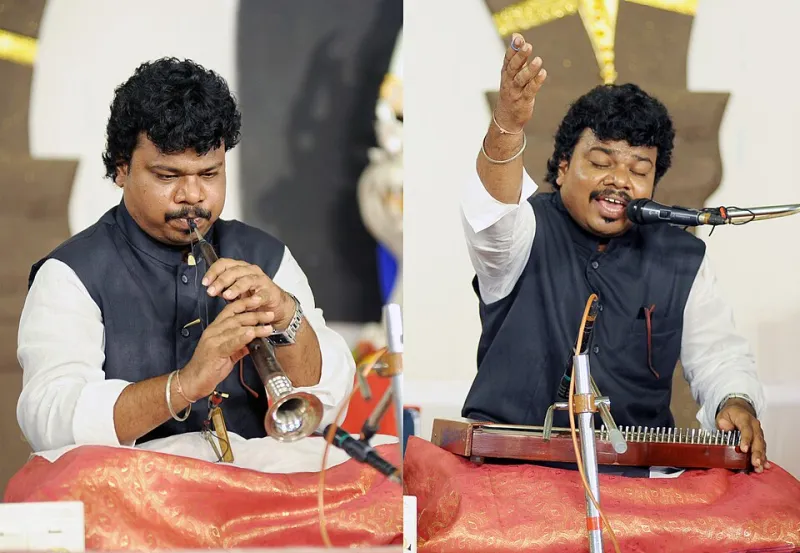
Photo: Shiva2586, CC BY-SA 3.0, via Wikimedia Commons
A Crisis That Statistics Cannot Fully Capture
The numbers are stark enough on their own. According to the Anxiety and Depression Association of America, anxiety disorders affect more than forty million adults in the United States — making them the most common mental health concern in the country. But statistics rarely capture the texture of modern American anxiety: the 2 a.m. spiral, the low-grade hum of dread that persists through otherwise ordinary afternoons, the sense that the nervous system never quite returns to baseline.
Conventional responses — therapy, medication, breathwork, mindfulness apps — offer genuine relief to many. Yet a quiet but growing number of wellness practitioners and curious listeners are turning toward something far older and, in the American context, considerably more unfamiliar: the Indian classical raga.
What they are discovering is not merely pleasant music. They are encountering a system of extraordinary sophistication — one that has been engineering specific emotional and physiological states through sound for over two thousand years.
The Architecture of a Raga
To understand why ragas occupy a unique position in the wellness conversation, it helps to understand what a raga actually is — and what it is not.
A raga is not a melody in the Western sense, nor is it a scale, though it contains elements of both. It is better described as a living sonic personality: a specific collection of notes, ornaments, characteristic phrases, and — crucially — a prescribed relationship to time. Each raga belongs to a particular hour of the day or season of the year. Raga Bhairav is performed at dawn; Raga Yaman at dusk; Raga Darbari Kanada in the deep watches of the night.
This temporal dimension is not aesthetic preference. It reflects the classical Indian understanding that the human body's internal rhythms — what modern science now calls circadian biology — are in constant dialogue with the external environment. Performing or listening to a raga at its prescribed time amplifies its effect because the listener's physiology is already oriented in the same direction the music is moving.
The great masters of the tradition — figures whose lineages extend back through centuries of unbroken transmission — understood this not as theory but as lived practice. Gajanan Maharaj's own engagement with the devotional dimensions of Indian classical music reflects this same understanding: that sound, when approached with the correct intention and at the correct moment, becomes a vehicle for states of awareness that ordinary language cannot easily reach.
What Neuroscience Is Beginning to Confirm
Western researchers have only recently begun investigating what Indian musicians have practiced for millennia. Studies conducted at institutions including the National Brain Research Centre in India have found that listening to specific ragas produces measurable changes in brainwave patterns, shifting listeners from high-frequency beta states — associated with stress and analytical thinking — toward the slower alpha and theta frequencies linked to relaxed alertness and creative cognition.
Raga Bhairavi, traditionally associated with devotion and the tender ache of parting, has shown particular promise in studies examining its effect on cortisol levels. Raga Desh, with its monsoon associations and expansive melodic character, has been linked to elevated mood and reduced physiological markers of anxiety.
Perhaps most intriguing to researchers is the raga's relationship to meend — the continuous gliding between notes that characterizes Indian classical performance. Unlike the discrete pitch steps of Western equal temperament, meend creates a kind of sonic continuum that some neurologists believe engages the auditory cortex in ways that promote neural integration, the process by which different regions of the brain synchronize their activity. It is a process that chronic stress actively disrupts.
Digital Platforms and the Algorithm's Unexpected Gift
For decades, Indian classical music occupied a respectful but narrow niche in the American cultural landscape — appreciated by South Asian diaspora communities and a dedicated circle of world music enthusiasts, but rarely penetrating mainstream wellness culture. That geography is shifting, and the mechanism driving the shift is one that classical purists might have least expected: the recommendation algorithm.
On platforms like YouTube and Spotify, the logic of the algorithm has proven unexpectedly hospitable to raga content. Listeners searching for sleep music, focus playlists, or anxiety relief are increasingly being served hours-long recordings of sarod, sitar, and bansuri — often performed by artists who recorded these pieces without any explicit wellness framing, simply as expressions of their tradition.
Channels dedicated to specific ragas for specific times of day have accumulated millions of views from American listeners who may know nothing of the theory underpinning what they are hearing, yet report profound effects on their stress levels and sleep quality. TikTok, meanwhile, has introduced shorter-form raga content to younger audiences through creators who bridge the gap between classical knowledge and contemporary accessibility — explaining the emotional character of a raga over a visually compelling performance clip.
This democratization carries both promise and responsibility. The raga tradition is not background music. At its fullest expression, it demands an attentive listener willing to follow the musician's journey through slow development, sudden revelation, and quiet resolution. The short-form format inevitably strips much of this away.
Listening as a Healing Practice
For American audiences genuinely drawn to what the raga tradition offers, practitioners and scholars suggest that intention matters as much as exposure. Passive streaming, while not without benefit, is different from what the tradition calls sravana — attentive, devoted listening that treats the music as a form of dialogue rather than ambient content.
This might mean setting aside thirty minutes to listen to a single raga at its appropriate time of day, without multitasking. It might mean learning the names and characters of a few ragas, allowing familiarity to deepen the listening experience over time. Some American wellness practitioners are beginning to incorporate live raga performance into therapeutic settings — a development that would not have surprised the tradition's ancient architects in the least.
The healing properties of Indian classical music were never a secret. They were simply waiting, encoded in centuries of performance practice, for the right moment of cultural readiness to arrive. In an America grappling with an anxiety crisis that its existing wellness infrastructure has not fully resolved, that moment appears, note by careful note, to be unfolding.