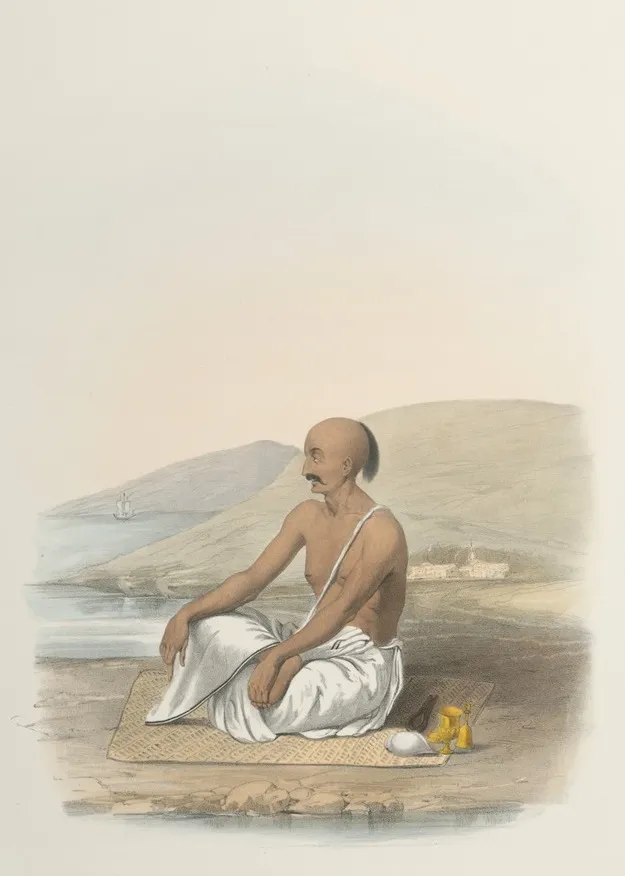
Surrender Is Not Weakness: What the Guru-Shishya Bond Reveals About True Transformation

Photo: Kmr ashish, CC BY-SA 3.0, via Wikimedia Commons
The Self-Help Shelf and Its Quiet Limitations
Walk into any major American bookstore, and the self-improvement section stretches like a horizon — hundreds of titles promising reinvention in thirty days, six habits, or one transformative morning routine. Coaching apps generate billions in revenue. Motivational retreats sell out within hours. By every external measure, the United States has built the most elaborate personal development industry in human history.
And yet, a persistent restlessness endures. Despite the abundance of tools, frameworks, and certified coaches, many Americans report feeling spiritually adrift, caught in cycles of temporary inspiration followed by the familiar gravity of old patterns. Something, it seems, is structurally missing.
The Indian philosophical tradition has a word for what that missing element might be: shraddha — a concept that translates imperfectly as faith, but carries deeper connotations of sustained, devoted attention offered to a living source of wisdom. It is the foundational attitude of the shishya, the student, toward the guru, the teacher. And it is precisely the quality that transactional self-improvement culture is least equipped to cultivate.
What the Guru-Shishya Relationship Actually Demands
In classical Indian spiritual traditions — whether rooted in Vedanta, Bhakti, Shaiva philosophy, or the living lineages of figures like Gajanan Maharaj — the relationship between teacher and student is not a service transaction. It is a covenant. The shishya does not arrive with a checklist of desired outcomes. The guru does not offer a packaged curriculum with a satisfaction guarantee.
What unfolds instead is something more akin to an extended apprenticeship of the soul. The student observes the teacher's life directly — not merely their teachings, but their manner of eating, resting, speaking, and remaining silent. Knowledge is transmitted through proximity, through seva (selfless service), and through years of patient absorption. The guru, in turn, reads the student's readiness and calibrates what is shared and when.
This is not a passive arrangement. The shishya is expected to bring tremendous discipline, humility, and an honest willingness to be corrected. But the correction comes from a place of deep relationship rather than professional obligation. The guru is not accountable to a client. The student is not purchasing an experience.
Critically, this tradition recognizes that genuine transformation is not linear. It does not arrive on schedule. The great sage Ramana Maharshi spent years in silent self-inquiry before awakening. Swami Vivekananda sat at the feet of Sri Ramakrishna for years, often in confusion, before the full transmission of wisdom clarified within him. The timeline is interior, not contractual.
America's Transactional Framework and Its Hidden Costs
American coaching culture, for all its genuine warmth and practical utility, operates on fundamentally different premises. It values measurable progress, client autonomy, and the idea that the seeker ultimately knows what they need — the coach simply facilitates the journey. This is a noble model within its proper domain. Executive coaching, therapeutic support, and skills development genuinely benefit from structured, goal-oriented engagement.
But when this framework is applied to spiritual transformation, the results are often superficial. The seeker remains the sovereign authority over their own development, selecting teachings the way one selects items from a menu. Discomfort is minimized. Difficult truths are softened. The relationship ends when the contract expires.
Perhaps most significantly, the American model is deeply averse to surrender — a word that carries unfortunate connotations of weakness or defeat in a culture that prizes individual agency above nearly everything else. Yet in the Indian tradition, surrender to a genuine guru is not the abdication of selfhood. It is the most sophisticated act of discernment available: the recognition that the ego's strategies for self-improvement are precisely the obstacle to genuine transformation.
Shraddha as a Practice, Not a Prerequisite
This does not mean that Western seekers are excluded from the depth these traditions offer. Gajanan Maharaj's own teachings remind us that wisdom does not belong to geography. The question is one of approach.
For Americans drawn to Indian spiritual traditions, a meaningful first step is releasing the consumer mindset at the threshold. This means engaging with teachings as living transmissions rather than information products, and approaching teachers — even those encountered through books, recordings, or digital platforms — with a quality of genuine receptivity rather than critical evaluation alone.
It also means accepting a longer timeline. The richness of the guru-shishya relationship was never designed to produce quarterly results. It was designed to dissolve the very self that measures results. That process, by its nature, unfolds across seasons, years, and sometimes lifetimes.
Practically, this might mean committing to one tradition or one teacher's body of work deeply rather than sampling widely. It might mean incorporating seva — service without expectation of return — as a spiritual practice in itself. It might mean sitting with a teaching that feels uncomfortable rather than immediately seeking a more palatable alternative.
What Authentic Engagement Actually Looks Like
The guru-shishya tradition does not require an American seeker to relocate to an ashram or renounce modern life. What it does require is a fundamental reorientation of intention. The question shifts from "What can I gain from this teaching?" to "What is this teaching revealing about the nature of my seeking itself?"
In that shift lies the beginning of something the self-help industry, with all its resources, cannot easily manufacture: genuine interior stillness. Not the temporary calm of a guided meditation, but the quiet that arises when the compulsive need to improve, optimize, and achieve begins, ever so gradually, to loosen its grip.
This is what the ancient Indian traditions have always pointed toward. Not a better version of the existing self, but a direct encounter with what lies beneath the self entirely. The guru, in this light, is not a service provider. The guru is a mirror held steady, reflecting what was always already present — waiting, with infinite patience, for the student to stop looking elsewhere.